




Sourcing a braided cable sleeve is not a matter of picking a size off a shelf. A braided sleeve is defined by its material, its expansion range, its flat width, its colour and its cut length — and a braided cable sleeve manufacturer that controls its own braiding and finishing can set all five to your drawing, while a distributor can only sell what is already in stock. This guide explains what genuinely differs between the two, which material suits which environment, and how to write an enquiry that returns a usable quotation the first time instead of three rounds of samples.
Braided Cable Sleeve Manufacturer vs Distributor
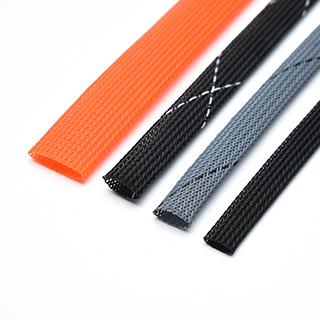
The practical difference shows up the moment your requirement falls outside a catalogue. A distributor can quote a stock flat width in black; a manufacturer can change the carrier yarn, the pick density, the expansion window and the colour, then cut it to the length your line actually consumes. For custom braided sleeving that is the whole point of going direct, because the variables that decide whether the sleeve installs cleanly are exactly the ones a stockist cannot touch.
| Capability | Braided sleeve manufacturer | Distributor / stockist |
|---|---|---|
| Carrier material | Braids PET, PA/PET hybrid, aramid and glass to order | Sells the grades already on the shelf |
| Expansion window | Set by pick density during braiding | Fixed to the bought-in specification |
| Colour | Standard black and grey, plus custom colours to order | Limited to stocked colours |
| Cut length | Continuous reels or pre-cut pieces to your length | Reels only, cut at the bench |
| Tolerance control | Flat width and expansion held across the lot | Inherits the mill tolerance |
If your annual volume is low and a stock size already fits, a distributor is the faster route. The moment you need a non-standard flat width, a tighter expansion band, a specific colour or pre-cut lengths, the comparison stops being about price per metre and starts being about who can hold the specification. That is the practical line between a braided sleeving manufacturer and a reseller: one can hold the specification, the other can only forward it.
Braided Sleeve Materials and Where Each One Belongs
Material selection decides the service temperature, the abrasion performance and the certification you can claim. Match the sleeve to the harshest condition in the application — temperature, abrasion or chemical exposure — rather than to the average condition.
| Material | Construction | Service temperature | Best-fit applications |
|---|---|---|---|
| PET expandable braided sleeving | PET monofilament, up to 50% radial expansion | -40 °C to +150 °C | Wire harness bundling, automotive, AV and computer cabling |
| PA/PET hybrid expandable sleeving | Polyamide blended with PET, expandable braid | -40 °C to +150 °C | Automotive, industrial and aerospace harnesses needing higher abrasion resistance |
| Kevlar braided sleeving | Aramid fibre braid, GD-KLB series | High-temperature, high-tensile service | Extreme environments where cut-through and tensile strength matter |
| Fiberglass high-temperature sleeving | Glass fibre braid with flame-retardant finish | Continuous high-temperature service | Heat shielding and thermal insulation of cables and hoses |
| Fabric heat shrink braided sleeving | Polyester fibre and polyolefin monofilament, radiation cross-linked | Shrinkable under heat | Applications needing a snug, shrink-fitted cover over irregular shapes |
A PET braided sleeve manufacturer will normally stock black and grey as standard because those cover the bulk of harness work. Where a program needs a specific colour for identification, or an expandable braided sleeve with a wider expansion window for a multi-branch harness, those are the requests that justify going to the source rather than a reseller. Choosing an expandable braided sleeve manufacturer that braids in house is what makes that wider window achievable without changing the base material.
What Can Be Customised in a Braided Cable Sleeve
Most buyers assume custom braided sleeving means a non-standard diameter. In practice the customisable envelope is wider, and several of the items below are what actually decide whether the part works on the line. A custom cable sleeve is rarely one change — it is usually two or three of these variables moving together.
| Variable | What can be customised | Why buyers ask for it |
|---|---|---|
| Material blend | PET, PA/PET hybrid, aramid, glass fibre | Temperature and abrasion performance drive the yarn choice |
| Flat width | Any nominal size within the braiding range | Standard sizes can leave the bundle loose or over-tight |
| Expansion window | Set by pick density during braiding | Controls how far the sleeve opens over connectors and branches |
| Colour | Black and grey as standard, custom colours to order | Circuit and harness identification |
| Cut length | Continuous reels or pre-cut pieces | Pre-cut lengths remove a measuring step from assembly |
| Flame retardancy | Flame-retardant yarns and finishes | Specifications that reference a flammability rating |
Sizing an Expandable Braided Sleeve
Expandable braided sleeve is quoted by its flat width, not by a rigid inside diameter, because the braid opens and closes with the bundle. The two numbers that matter are the flat width as supplied and the expansion range, and the bundle you need to cover has to sit inside that range with the sleeve neither slack nor stretched to its limit.
| What you specify | What it controls | Practical note |
|---|---|---|
| Flat width | The size of the sleeve as supplied | Measure the widest point of the bundle, then choose the flat width below it |
| Expansion range | How far the braid opens over connectors | PET braids commonly open up to about 50% radially |
| Bundle diameter | The final fitted size on the harness | Leave the sleeve slightly under tension so it grips without crushing |
| Cut length | Reel length or pre-cut piece length | Allow for the sleeve shortening slightly as it expands over the bundle |
Send the flat width, the expansion range you need and the largest bundle diameter the sleeve has to clear, and a manufacturer can confirm the size that fits rather than leaving you to guess between two catalogue entries.
Certifications and Compliance to Ask For
Compliance is where a cheap quotation quietly differs from a qualified one. Rather than asking a supplier whether they are "certified", ask for the specific claim that applies to your market, and ask for it in writing against the part number you are buying.
| Claim | What it covers | Ask for |
|---|---|---|
| Flammability rating | Vertical flame performance of the sleeve material | The rating and the test it was measured against |
| RoHS | Restricted hazardous substances in electrical equipment | Declaration of conformity per part number |
| REACH | Substance registration and SVHC content in the EU | SVHC statement against the current candidate list |
| ISO 9001 | Quality management system behind the process | Current certificate with scope and expiry |
How to Vet a Braided Cable Sleeve Supplier
Most sourcing problems trace back to a supplier who could sell sleeve but could not control the process. These five questions separate the two, and any cable protection sleeve manufacturer should be able to answer all of them without a referral.
1. Do you braid and finish in house, or resell?
A manufacturer that runs its own braiding and finishing can hold flat width and expansion across a production lot and build a non-standard colour or yarn blend. A reseller can only pass on what the mill shipped.
2. Can you hold a tolerance across the lot?
Ask for the flat-width tolerance and the expansion range as measured, not as nominal. Consistent numbers across lots are what keep a harness line running without rework.
3. Which materials can you run?
A supplier limited to PET cannot solve a high-temperature or high-abrasion problem. Confirm they can run the material your application actually needs before you send a drawing.
4. What is the minimum order and lead time for a custom colour?
Colour changes usually carry a minimum run. Knowing the threshold up front tells you whether a custom colour is worth it at your volume or whether a standard black or grey will do.
5. Can you supply pre-cut lengths?
If your line consumes fixed lengths, pre-cut supply removes a bench step and the waste that comes with it. Ask for a cut-length tolerance and how the ends are finished.
What to Put in a Braided Sleeving Enquiry
A complete enquiry returns a quotable part number instead of a question. Include these eight items and a manufacturer can respond with a real price rather than a range:
- Material and construction (PET, PA/PET hybrid, aramid or glass fibre)
- Flat width as supplied, and the expansion range you need
- Largest bundle diameter the sleeve must clear
- Colour, and whether a custom colour is required
- Cut length, or reel length if supplied on reels
- Service temperature and any flammability requirement
- Annual volume and the first delivery date you are working to
- Any certification you must be able to show your customer
Frequently Asked Questions
What is the difference between a braided cable sleeve supplier and a stockist?
A supplier that also manufactures can change the yarn, pick density, colour and cut length, so it can meet a specification that falls outside the catalogue. A stockist can only sell what it has bought in, which is fine for a standard size but not for a custom braided cable sleeve.
Can Kevlar Braided Sleeving be cut to length without fraying?
Aramid braid is normally cut with a hot knife or a suitable blade that fuses or traps the ends, or the ends are heat-sealed after cutting. If fraying at the cut is a concern on your line, ask the manufacturer to supply pre-cut lengths with finished ends rather than reels.
Is fiberglass braided sleeve suitable for high-temperature cable protection?
Yes. Glass fibre braid is chosen where the sleeve has to survive continuous heat that would degrade a PET or PA/PET braid. Confirm the service temperature of the specific finish, since coatings and binders can lower the usable limit.
What is the minimum order for custom braided sleeving?
It depends on whether the change is only a cut length and colour or a new yarn and expansion window. Colour and cut length usually carry the lowest minimum because they do not change the braid itself; a new material or expansion window carries a higher minimum. Ask for both thresholds in the same quotation so you can compare.
If you are specifying a braided sleeve for a harness or a cable protection program and want the material, flat width and expansion confirmed against your drawing, send your requirement to our engineering team and we will come back with the size that fits rather than a range to choose from.