




What Should You Check Before Installing a Braided Cable Sleeve?
Installing a braided cable sleeve is a simple and effective way to protect wires and cable assemblies from abrasion, friction, vibration, and mechanical damage. However, selecting the right sleeve is only part of the installation process. Before covering a cable bundle with braided sleeving, several important conditions should be checked to make sure the wiring remains safe, flexible, and reliable during operation.
A properly installed braided cable sheath should protect the cable without creating additional stress. The following checks can help prevent common installation problems and improve the long-term performance of the cable assembly.
1. Check the Cable Condition First
Before installing any protective sleeve, inspect the cable itself. Look for cuts, cracks, exposed conductors, damaged insulation, loose terminals, or signs of overheating.
A protective sleeve should not be used to cover an already damaged cable and assume that the problem has been solved. If the insulation is damaged or a connector is loose, the cable should be repaired or replaced before the sleeve is installed.
It is also important to check whether the cable has been exposed to oil, chemicals, excessive heat, or other substances that may affect the insulation material.
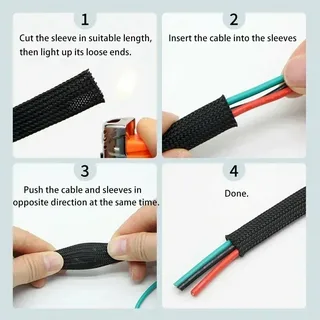
2. Measure the Complete Cable Bundle
Do not select the sleeve based only on the diameter of one wire. Measure the outside diameter of the complete cable bundle that needs to be protected.
This is particularly important for expandable braided sleeving because the sleeve has a specific expansion range. A sleeve that is too small may compress the cables excessively, while one that is too large may not provide sufficient coverage or may move during operation.
When several wires, connectors, or small hoses are bundled together, consider the largest cross-section of the assembly before choosing the sleeve size.
3. Check for Connectors and Terminals
Before installation, check the connectors, terminals, plugs, and other components attached to the cable.
The connector size can determine whether a conventional expandable sleeve can be installed directly. If the connector is significantly larger than the cable bundle, the sleeve may need to be expanded over it, or a split/side-entry design may be more practical.
Connectors should also be firmly secured. The braided sleeve is intended to provide cable protection and organization; it should not be relied upon to hold a poorly installed connector in place.
4. Check the Operating Temperature
Temperature is another important factor when selecting a cable protection sleeve.
Different materials have different temperature capabilities. Standard PET braided sleeves are suitable for many general cable-management applications, while specialized fiberglass or high-temperature sleeving may be required near engines, heaters, industrial processing equipment, or other heat sources.
Before installation, identify the normal operating temperature as well as possible temperature peaks. The sleeve should be selected according to the actual working environment rather than room temperature alone.
5. Check for Sharp Edges and Friction Points
Pay close attention to the cable route.
If the cable passes close to metal edges, brackets, screws, moving components, or other abrasive surfaces, the sleeve may experience continuous friction during operation. A braided sleeve can provide an additional protective layer, but the surrounding structure should still be checked.
Where necessary, remove sharp edges, adjust the cable route, or add suitable fastening and protective components.
This is particularly important in automotive wiring, industrial machinery, robotics, and other applications where vibration or repeated movement occurs.
6. Make Sure the Cable Can Move Freely
A protective sleeve should not restrict the normal movement of the cable.
For moving cable assemblies, leave enough flexibility at bending points and avoid installing the sleeve under excessive tension. The cable should be able to bend according to its required bending radius without being forced into a sharp angle.
This is especially important for robotic equipment, automated machinery, moving platforms, and other dynamic applications.
If you want to understand more about proper installation methods, see our related guide on How to Use Braided Cable Sleeve.
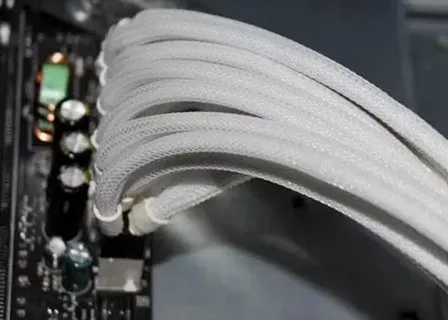
7. Check the Sleeve Length
Measure the required installation length before cutting the sleeve.
The sleeve should provide adequate coverage without interfering with connectors, terminals, moving joints, or mounting points. Avoid making the sleeve unnecessarily long if the excess material could become trapped in moving components.
When cutting expandable braided sleeving, the cut edge should also be secured properly to reduce fraying and maintain the integrity of the woven structure.
8. Check How the Sleeve Ends Will Be Secured
The ends of the sleeve should be secured so that the braided material does not gradually move along the cable during operation.
Depending on the application, cable ties, clamps, heat-shrink tubing, or other suitable fastening methods can be used.
The fastening method should hold the sleeve securely without damaging the cable insulation. Excessive compression at the ends should also be avoided, particularly when the cable assembly needs to move.
9. Check Chemical and Environmental Exposure
Cable protection requirements can change depending on the environment.
Before selecting a braided cable sheath, check whether the cable will be exposed to oil, water, solvents, cleaning chemicals, UV radiation, dust, or other environmental conditions.
A sleeve that performs well in an indoor electronic application may not be suitable for an outdoor or industrial environment. Material compatibility should therefore be considered together with temperature and mechanical requirements.
10. Perform a Final Inspection After Installation
After the sleeve has been installed and secured, perform a final inspection before the equipment is put into operation.
Check that the cable is fully covered where protection is required, the sleeve is not excessively stretched, and there are no sharp edges or loose sections. Move the cable through its normal range of motion and make sure the sleeve does not interfere with connectors, hinges, motors, or other moving components.
For critical cable assemblies, it is also useful to inspect the installation after an initial period of operation. This can reveal movement, fraying, abrasion, or fastening problems that were not visible during the initial installation.
Final Checklist for Braided Cable Sleeve Installation
Before putting the protected cable into service, confirm the following:
Cable insulation is intact and undamaged.
The complete cable bundle has been measured.
The sleeve diameter is suitable for the bundle.
Connectors and terminals are properly secured.
The sleeve material matches the operating temperature.
Sharp edges and potential friction points have been checked.
The cable has enough room to bend and move.
The sleeve length is appropriate.
Both sleeve ends are properly secured.
Environmental and chemical exposure has been considered.
The complete installation has been inspected after assembly.
A braided cable sleeve works best when the cable, sleeve, installation method, and working environment are considered as one complete system. Taking a few minutes to inspect the wiring before installation can prevent premature wear and unnecessary maintenance later.
For manufacturers and engineers looking for practical cable protection solutions, choosing the correct braided sleeving according to cable diameter, temperature, movement, abrasion, and environmental conditions is essential for reliable long-term performance.