




What Is Noise Reduction Self-Closing Sleeving?
Noise Reduction Self-Closing Sleeving is a specialized cable protection sleeve designed for wire harnesses, tubes, and cable bundles operating in vibration-sensitive environments. Unlike conventional braided sleeving, its overlapping self-closing structure allows quick installation without disconnecting connectors or terminals.
The unique multilayer polyester construction creates a cushioning barrier between cables and surrounding structures, helping reduce rattling, friction noise, and vibration-induced wear. This makes it particularly suitable for automotive dashboards, EV battery harnesses, railway systems, industrial automation equipment, and communication cabinets where noise control and abrasion resistance are equally important.
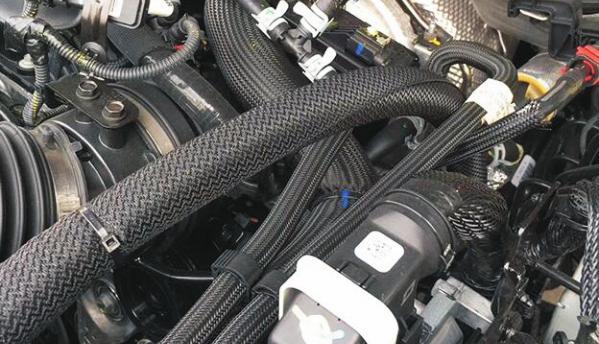
Key Technical Advantages
| Performance Item | Specification | Benefit |
|---|---|---|
| Operating Temperature | -50℃ to +150℃ | Suitable for automotive engine compartments and industrial equipment |
| Melting Point | 240℃ ±10℃ | Maintains structural integrity under high heat exposure |
| Flame Rating | UL94-V1 | Improves fire safety of cable assemblies |
| Material | Polyester Monofilament + Multifilament | Excellent flexibility and abrasion resistance |
| Structure | Self-Closing Overlap Design | Fast installation and easy maintenance access |
| Environmental Compliance | RoHS & Halogen-Free | Meets international environmental standards |
Typical Applications
Automotive Wire Harness Protection
Modern vehicles contain hundreds of electrical circuits routed through dashboards, doors, pillars, and engine compartments. Continuous vibration can cause harness movement, resulting in noise generation and insulation wear. Noise Reduction Self-Closing Sleeving minimizes cable-to-cable and cable-to-structure contact while providing long-term abrasion protection.
Electric Vehicle Battery Systems
EV battery packs contain high-density wiring systems exposed to thermal cycling and vibration. The sleeving helps organize cable routing while protecting sensitive wiring from friction damage and unwanted movement during vehicle operation.
Industrial Automation Equipment
Robotic arms, automated conveyors, and CNC machinery often experience repetitive cable movement. The self-closing design simplifies installation and maintenance while reducing wear caused by continuous motion.
Rail Transit and High-Speed Rail
Railway electrical systems require durable protection against vibration, abrasion, and environmental stress. The sleeving provides an effective solution for maintaining harness reliability in long-term service conditions.
Why Choose Self-Closing Sleeving Instead of Traditional Cable Wrap?
| Feature | Noise Reduction Self-Closing Sleeving | Traditional Spiral Wrap |
|---|---|---|
| Installation Speed | Very Fast | Moderate |
| Connector Removal Required | No | Usually Yes |
| Noise Reduction | Excellent | Limited |
| Abrasion Protection | High | Medium |
| Maintenance Access | Easy | Difficult |
| Reusability | Yes | Limited |
Industries Served
Automotive OEM Wire Harness Manufacturing
Electric Vehicle Battery Systems
Industrial Automation Equipment
Railway and High-Speed Rail Systems
Telecommunication Equipment
Power Distribution Cabinets
Industrial Robotics
Electronic Control Systems
Frequently Asked Questions
Can the sleeving be installed without disconnecting cables?
Yes. The side-entry self-closing design allows installation over existing wire harnesses without removing connectors or terminals.
Is the sleeving suitable for automotive applications?
Yes. It is widely used in dashboards, engine compartments, door harnesses, and EV battery systems where vibration and abrasion protection are required.
Does the sleeving provide flame resistance?
Yes. The material meets UL94-V1 flame retardancy requirements and is suitable for demanding electrical protection applications.
What cutting method is recommended?
A hot knife cutter is recommended to prevent fraying and ensure clean edge sealing.
Can custom colors and packaging be supplied?
Yes. Custom colors, dimensions, and packaging configurations are available according to project requirements.